Inflatable Standing Paddle Board Buyer’s Guide for Brownsville Paddlers
An inflatable standing paddle board is a portable, durable board that packs into a backpack. Here’s how to pick the right size, build and kit, and when to retire it.
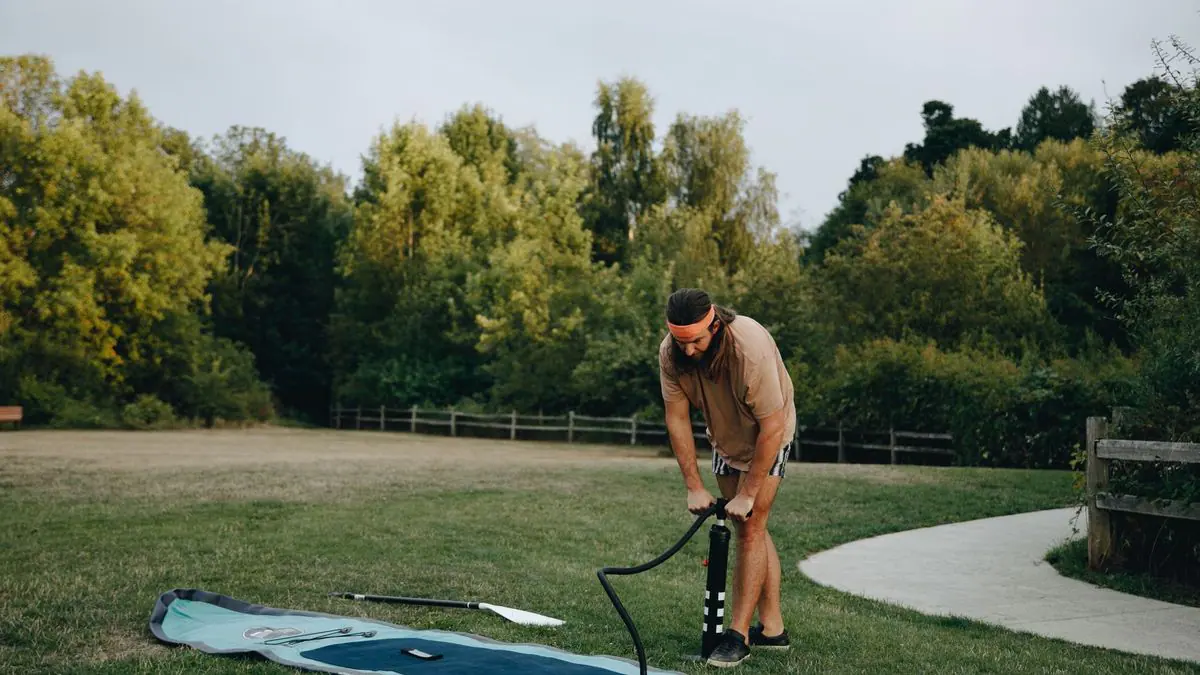
What Is an Inflatable Standing Paddle Board, and Is It Worth Buying?
An inflatable standing paddle board is an air-filled board you stand on and paddle. It is built from drop-stitch PVC, inflates to about 12–15 PSI and turns rigid enough to feel like a hard board. Deflated, it rolls into a backpack-style bag. For most people with limited storage or a small car, it is worth buying.
That is the short version. Here is why it works and who it suits.
Why it packs small. The board is a sealed air chamber. When you open the valve and roll it up, it shrinks to roughly the size of a sleeping bag. You can carry it on your back, fit it in a trunk, check it on a flight or hike it to a remote lake.
Why it stays durable. Thousands of thin fibers, called drop-stitch threads, join the top and bottom layers inside the board. They hold the shape when the board is pumped up. PVC outer layers shrug off bumps against docks and rocks better than many people expect. Owners also say inflatables are more forgiving when you fall, since the surface is softer than a hard board.
Who benefits most.
- Apartment dwellers and anyone without a garage or rack space.
- Travelers who want a board in the trunk, not on the roof.
- Beginners who want a stable, forgiving first board.
- Paddlers who use lakes, slow rivers and calm coastal water.
Who may prefer a hard board. If you have plenty of storage and want the sharpest performance, a solid board can still make sense. Many reviewers point to that as the main trade-off.
The catch. Inflation takes effort. A basic pump works but is tiring, and one reviewer noted that many people end up buying an electric pump, which he put at about $150. Factor that into your budget. Also plan to dry the board before storing it.
So are inflatable stand up paddle boards worth it? Yes, if portability, easy storage and durability matter to you. The next sections cover size, materials, kit contents, price tiers and when to retire a board, so you can buy with confidence.
How Do You Choose the Right Size for Your Inflatable Paddle Board?
Match the board to your weight, your skill level and where you plan to paddle. For all-around use, most guides point to a board about 10 to 11 feet long, 32 to 34 inches wide and around 6 inches thick, with a weight capacity well above your body weight.
Here is how each measurement changes the ride.
Length. Shorter boards, around 9 to 10 feet, turn quickly and feel playful. Mid-length boards, around 10 to 11 feet, are the classic all-around size. Longer boards track straighter and glide farther, which suits touring, but they are harder to turn and to carry. Boards made for kids are typically around 8 feet long.
Width. Width is the biggest factor in stability. A wider board feels steadier under your feet, which helps beginners, yoga and anyone carrying extra gear. A narrower board is faster but wobblier. One widely shared Reddit rule of thumb says 10.5 to 11.5 feet long, 32 to 34 inches wide and 5 to 6 inches thick works for about 90% of people. Smaller paddlers should lean toward the lower end of those ranges.
Thickness. Thickness decides how stiff the board feels once inflated. A thicker board holds more air, flexes less under your weight and rides higher on the water. Around 6 inches is the usual all-around choice.
Weight capacity. Capacity is listed in lbs and covers you plus everything you bring: a dog, a child, a cooler, a dry bag. Do not buy a board that sits right at its limit. Staying well under it keeps the board stiffer, floating higher and easier to paddle.
| Measurement | Typical all-around range | What it changes |
|---|---|---|
| Length | 10 to 11 feet | Turning, speed, carrying ease |
| Width | 32 to 34 inches | Stability |
| Thickness | About 6 inches | Stiffness, float, load |
| Weight capacity | Well above your total load in lbs | Performance under weight |
Before you buy, check the maker’s size and weight chart, and think about the heaviest load you will carry, not just your own weight. When two sizes both fit, most beginners do better on the wider one.
What Is the Best Inflatable Stand Up Paddle Board for Beginners?
The best inflatable stand up paddle board for beginners is a wide, thick, all-around board with a rounded nose and a weight capacity well above your total load in lbs. Aim for roughly 10 to 11 feet long, 32 to 34 inches wide and about 6 inches thick. Stability matters more than speed when you are learning.
Instead of chasing one model, judge any board by these traits.
Width first. A wider deck gives you a steadier platform and more room to find your feet. If two boards are close in length, the wider one will usually feel calmer on your first outings. Most beginner guides point to 32 inches or more.
A mid-length, all-around shape. Boards around 10 to 11 feet are the classic all-around size. They turn without feeling twitchy and still track reasonably straight. Very short boards pivot fast but can feel tippy. Very long boards are harder to turn and to carry.
Enough thickness. A board around 6 inches thick stays stiff under your weight. A soft, bendy board feels unstable and tires you out.
Real weight margin. Pick a capacity that sits comfortably above you plus your gear. A board near its limit sits lower in the water and feels sluggish. Smaller paddlers should lean toward the lower end of the size ranges.
A complete kit. Beginners do best with a package that includes a pump, adjustable paddle, leash, removable fin and carry bag, so you can get on the water the same day.
A deck pad you like. Look for a full-length, grippy traction pad. It keeps your feet planted when the board moves.
You may see roundups naming budget boards with prices in the low hundreds of dollars. Treat those as a starting point, not a verdict. Check the size, capacity, build and what is in the box before you buy.
Many new paddlers say they started with a stable inflatable because it forgave falls and was easy to store. If you are coming from kayaking or have back pain that rules out sitting, a wide board lets you stand, kneel or sit while you build confidence.
Start on calm, flat water, kneel first if you need to, and move to standing once the board feels steady.
What Should You Look for in Construction and Materials?
Look for a drop-stitch core, multiple PVC layers, reinforced rails and a PSI rating of about 12 to 15. Together, these decide how stiff the board feels and how well it handles bumps, sun and repeated use. Size gets you a board that fits you. Construction decides how long that fit lasts.
Drop-stitch core. Thousands of thin fibers join the top and bottom layers inside the board. When you pump it up, the fibers pull tight and hold a flat shape. This is why a good inflatable feels almost as rigid as a hard board. Denser stitching generally means a flatter, stiffer deck.
PVC layers. The outer skin is PVC, often described as military-grade. Makers bond or laminate more than one layer to resist scrapes, dings against docks and rocks, and everyday wear. Check the product page for how the layers are built. If a listing says nothing about construction, treat that as a warning sign.
Rail construction. Rails are the board’s edges, and they take the most abuse. Look for rails that are reinforced or taped along the seam. Weak seams are where leaks tend to start.
PSI rating. Most inflatable boards are pumped to about 12 to 15 PSI. Check the maximum rating on the board. A higher rating usually means a stiffer ride, but only if the build can hold it. Use a pump with a gauge so you know what you are actually reaching.
How quality shows up.
- Stiffness: A well-built board stays flat when you stand on it. A poor one bows in the middle.
- Durability: Good materials resist dings, scuffs and the wear of regular transport.
- Fit and finish: Look for clean seams, solid handles, a firmly attached traction pad and sturdy fin mounts.
What to check before buying. Read the specifications, not just the marketing. Look for the PSI rating, thickness, weight capacity in lbs and a description of the core and PVC. Check whether the seller offers a warranty or repair support, and read what it covers.
Do not choose on price or looks alone. A board that holds its shape and its air will serve you far longer than one that only looks good in photos.
What Comes in the Kit, and Which Accessories Are Worth Adding?
Most inflatable standing paddle board packages come as a complete kit. You typically get the board, a manual or dual-action pump, an adjustable 3-piece paddle, a safety leash, removable fins and a backpack-style carry bag. Once the board fits you and the build looks sound, check what arrives with it.
What is usually in the box.
- Board: the inflatable deck with a traction pad, handles and attachment points.
- Pump: a manual or dual-action hand pump that fills the board to about 12 to 15 PSI in roughly 5 minutes.
- Paddle: an adjustable 3-piece paddle that breaks down to fit in the bag.
- Leash: keeps the board attached to you if you fall.
- Fins: removable fins that help the board track straight.
- Backpack: a carry bag for the rolled-up board and, in many kits, the other parts.
What to check before buying. Kits differ, so read the listing closely. Confirm the pump has a pressure gauge. Check that the paddle adjusts to your height and feels sturdy. Look at the leash length and cuff. See whether the bag is comfortable to carry and big enough to hold everything once the board is rolled. Also check whether a repair kit is included, since many kits add one for small punctures.
Accessories worth adding.
- Electric pump: inflating by hand takes effort. One reviewer noted that many owners end up buying an electric pump, which he put at about $150. Look for one that is compatible with your board’s valve.
- Personal flotation device: wear one whenever you paddle. It is a safety item you should not skip.
- Dry bag: keeps your phone, keys and snacks dry.
- Extra repair patches: small, light and easy to pack.
- Spare fin: useful if one gets damaged or lost.
What you can skip at first. Seats, cooler mounts and camera mounts are nice later. Start with the kit, a flotation device and a way to dry and store your board. Add extras only when you know how you paddle.
A complete kit saves you from piecing things together, but a cheap kit with a weak pump or flimsy paddle can spoil the day. Compare what is in the box, not just the board.
What Is the Best Inflatable SUP for the Money?
The best inflatable SUP for the money is the one that fits your size and weight, holds its air and arrives as a complete kit, not the one with the lowest sticker price. Budget boards can work well for casual paddling. Spending more tends to buy stiffness, better build and fewer headaches.
This page does not pick specific products. Here is how to judge value on any board.
Typical price tiers, in words.
- Entry level: priced in the low hundreds of dollars. Roundups often list complete kits here. Good for casual lake or bay paddling and occasional use.
- Mid range: a step up in price. You often see stiffer construction, better pumps and paddles, and more refined traction pads and handles.
- Premium: the highest tier. It usually adds specialized shapes, lighter materials, more compact packing and extras such as convertible seating.
Some Reddit shoppers set a firm limit, such as a family board for $400 or under. Setting your own ceiling first helps you compare fairly.
What changes the price.
- Core and PVC build, which affects stiffness and durability.
- Weight and how small the board rolls up.
- Quality of the pump, paddle, leash and bag.
- Special features, such as seats, extra attachment points or a multi-use design.
- Brand name, warranty and repair support.
Where spending less makes sense. If you paddle a few times a year on calm water, a basic complete kit can be plenty. Choose the right size and width first. A well-sized budget board beats a mismatched expensive one.
Where spending more makes sense. If you paddle often, carry heavier loads, travel with the board or want it to last, a sturdier build is worth it. You may also want to upgrade the pump. Owners report that many end up buying an electric pump, which one reviewer put at about $150.
Watch for false savings. A very cheap kit with a weak pump, flimsy paddle or poor seams can cost you more once you replace parts or the board. Check the PSI rating, weight capacity in lbs, what is in the box and what the warranty covers before you decide.
Value is the board you will actually use, that stays stiff and that fits your budget and your body.
How Long Does an Inflatable SUP Last, and When Should You Retire It?
A high-quality inflatable SUP can last 5 to 10 years with proper care, while budget or single-layer boards often wear out in 1 to 3 years. Retire your board when it develops chronic seam leaks, delaminates or can no longer hold safe air pressure. Those figures come from lifespan guides and are estimates, not guarantees.
Here is what shapes that range and how to tell when it is time to let go.
What affects lifespan.
- Build quality: Cheap boards from low-end brands may only last a couple of years. Well-built boards can serve you for a decade or more.
- How often you paddle: One guide says an average recreational paddler on the water once or twice a week can expect 5+ years. Daily use wears a board faster.
- Care: Rinsing, drying fully, avoiding heat and sharp objects, and storing the board properly all add years.
- Conditions: Sun, heat, rough shorelines and rocky launches are hard on any board.
When to retire a paddle board. Most guides skip this question. Look for these signs.
- Delamination: Bubbles, wrinkles or peeling in the outer PVC layer mean the bond is failing. This is hard to fix and tends to spread.
- Chronic seam leaks: A small leak you can patch is normal. A seam that keeps leaking after repair is a red flag.
- Repeated failed repairs: If patches will not hold, or new leaks keep appearing, the material is likely worn out.
- Loss of stiffness: If the board will not reach a firm, flat shape at its recommended PSI, or sags during a paddle, the core may be failing.
- Weak or damaged valve: A valve that will not seal reliably is a safety problem. Some can be replaced, so check first.
- Heavy surface damage: Large gashes, cracks or sun-faded, brittle material are signs the board is near the end.
What owners report. Reddit threads on this topic show people asking whether inflatables ever fail badly and how often others replace their boards. The common thread is that boards fail gradually, with leaks that get harder to fix, not all at once. Treat that as anecdote, not a rule.
Safety comes first. A board that loses air mid-paddle is a risk, especially on open water. If you doubt it, stop using it. Wear a flotation device and keep your leash on.
Small punctures do not mean the end. Retire the board when repairs stop working or safety is in question.
How Do You Inflate, Store and Care for Your Board?
To inflate your board, connect the pump to the valve and fill it to the recommended pressure, usually about 12 to 15 PSI. To care for it, rinse it after use, dry it completely, then store it clean and dry in a cool, shaded place away from direct sun and heat.
How to inflate it.
- Unroll the board on a clean, flat, soft surface such as grass or a mat, not on gravel or concrete.
- Set the valve to the open or inflate position, following the maker’s instructions.
- Attach the pump hose firmly to the valve.
- Pump steadily. A manual pump takes about 5 minutes for most boards, and an electric pump can save effort.
- Watch the gauge. Stop at the PSI printed on your board, never above it.
- Remove the hose quickly, close the valve and attach the fins.
How to clean and dry it.
- Rinse the board with fresh water after each trip, especially after salt water, sand or mud.
- Wipe off excess water with a towel.
- Let the board air dry fully in the shade. This helps prevent mold and mildew.
- Dry the bag, fins and leash too.
How to roll and store it.
- Open the valve and press out all the air.
- Roll the board snugly from the tail toward the nose, following the maker’s guidance, then strap it and place it in the bag.
- Store it in a cool, dry, indoor space out of direct sunlight.
- Keep it away from sharp tools, chemicals and anything heavy that could crush or scrape it.
Never store a board that is still damp. Moisture trapped in a bag is a common cause of odor and mold.
Handling heat. Hot weather is hard on inflatable boards. Do not leave an inflated board in direct sun, in a parked car or on hot pavement. Heat raises the pressure inside and can stress seams. In hot climates like South Texas, shade the board between sessions and let some air out if it sits in the sun.
Avoiding sharp objects. Check your launch spot for rocks, shells, oyster beds, thorns and rough concrete. Carry the board instead of dragging it.
Small punctures and tears. Find the leak by spraying soapy water and watching for bubbles. Small holes can often be fixed with the repair kit that comes with many boards. Follow the maker’s instructions, and let the patch cure fully before you inflate. For large tears or seam failures, contact the seller or a repair shop.
Check your board for wear now and then, and your inflatable standing paddle board will last longer.
What Mistakes Should You Avoid When Buying an Inflatable Paddle Board?
The most common mistakes are buying a board that is too narrow, ignoring weight capacity, choosing on looks or the lowest price, skipping safety gear and forgetting where you will store and carry the board. Avoid these, and you will likely be happy with your inflatable standing paddle board for years.
1. Buying too narrow. A narrow board is faster but less stable. For an all-around board, guides point to about 32 to 34 inches wide. If you are new, or you plan to carry a child, a dog or gear, lean toward the wider end.
2. Ignoring weight capacity. Capacity in lbs covers you and everything you bring. A board near its limit sits low in the water and feels sluggish and soft. Choose one with a real margin above your total load. Sizing for your weight matters more than chasing length.
3. Skipping the pump check. Look at what comes in the kit. A weak or gauge-free pump makes inflating a chore and can leave you under-inflated. Under-inflation is a common mistake, and it makes the board bend and feel unstable. Make sure you can reach the PSI printed on the board, usually about 12 to 15.
4. Choosing on looks alone. Color and graphics are fun, but buying for color before fit is a mistake that shows up on the first paddle. Check size, thickness, construction and what is in the box first. Pick the design you like from the boards that fit.
5. Chasing the lowest price. Ultra-cheap boards can wear out within a few years, and some guides warn against buying from big-box stores without checking the build. Look for clear specifications and a warranty, and read what it covers.
6. Forgetting safety gear. Plan for a leash and a personal flotation device. Wear them every time you paddle.
7. Overlooking storage and travel. Think about your trunk, closet or apartment space, and how far you will carry the bag. Check how heavy the packed board is, how small it rolls and whether the bag is comfortable.
8. Forgetting your launch spots. Gravel, sharp rocks, shells and hot asphalt can scrape or soften the PVC. Carry the board, and check the ground first.
Take your time, compare specifications and buy for how you will actually paddle.
Questions people ask before buying an inflatable paddle board
Still have a question?
Are inflatable stand-up paddle boards worth it?
Yes, if you have limited storage or want to travel with your board. They roll into a backpack, resist dings and feel rigid once pumped to about 12–15 PSI. A hard board can still suit you if you have plenty of space.
What is the best inflatable stand-up paddle board for the money?
The best value is a board that fits your size and weight, holds its air and comes as a complete kit. Check size, weight capacity in lbs, build and what is in the box before you compare prices.
What is the best inflatable stand up paddleboard for beginners?
Choose a wide, thick, all-around board, roughly 10 to 11 feet long, 32 to 34 inches wide and about 6 inches thick. Stability matters more than speed when you are learning.
What is the lifespan of an inflatable SUP?
Guides say a high-quality board can last 5 to 10 years with proper care, while budget or single-layer boards often last 1 to 3 years. These are estimates, not guarantees.
Do inflatables ever catastrophically fail?
Owners generally describe gradual failure, such as leaks that get harder to fix, not sudden collapse. Treat that as anecdote. Wear a flotation device and keep your leash on in case a board loses air.
When should you retire a paddleboard?
Retire it when it has chronic seam leaks, delamination, repairs that will not hold, or it cannot reach a firm shape at its recommended PSI. If you doubt it is safe, stop using it.
Is SUP repair possible for a torn inflatable?
Small punctures can often be patched with a repair kit. Let the patch cure fully before inflating. For large tears or seam failures, contact the seller or a repair shop.